

Learn English with stories you can't stop listening to.
Carlos arrived in London unable to understand his NHS doctor. 45 stories later, the journey reaches advanced English. From A1 to C1.
It's not a course. It's not a lesson. It's a 12-minute story in British English at real speed. You listen on the tube, in the kitchen, before bed. And when you finish, you've absorbed ten new English structures without opening a single grammar book.
That's how NexSpeak's 45 stories work. From knowing how to introduce yourself to handling advanced English with confidence. A1 to C1.
Fake English
You've spent months — maybe years — doing exercises in apps that reward you for clicking. You drag words, fill gaps, collect points. The app says you're progressing. But when your British boss speaks at real speed, you catch maybe half. When your NHS doctor explains something, you nod without knowing what was said. When your colleagues make a joke, you smile on autopilot.
It's not that you haven't studied. It's that what you were given wasn't real English. They were disconnected sentences, without context, without story, without anyone saying them for a reason. "The cat is on the table." Great. And when you need to tell your landlord the heating is broken, the cat is no help.
Real English has rhythm, context, and people saying things for a reason. You need to hear it that way for your brain to process it as language — not as exam code.
English stories that teach the way your brain actually learns
Every NexSpeak story is an episode from the real life of a Spanish speaker in the UK. It has named characters, a specific city, problems you recognise. And inside that story, grammar structures appear naturally — the way they appear in real life.
Before you listen, your brain already knows what's coming.
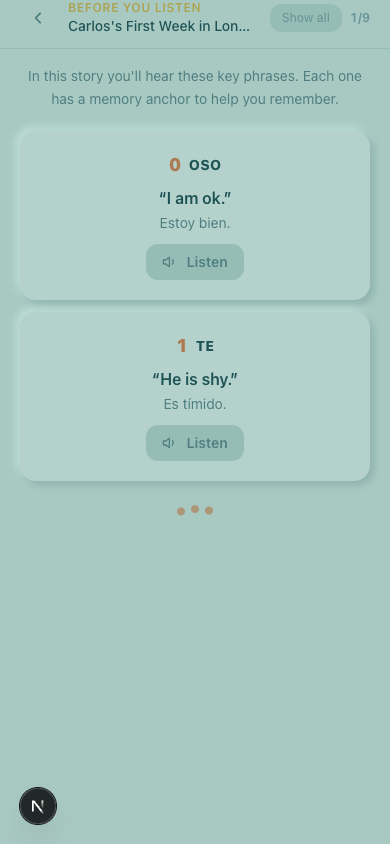
Ninety seconds before the main audio, the app shows you the structures you're about to hear. One by one. Each paired with its mnemonic image. It's not a test. It's a tuning — like adjusting the radio before the show.
When the structure appears in the real audio, your brain recognises it without effort. Not because it memorised it. Because it was waiting for it.
Cognitive science calls this pre-exposure (priming). We call it warming up the ear.
Play. Listen. Live the scene with Carlos.
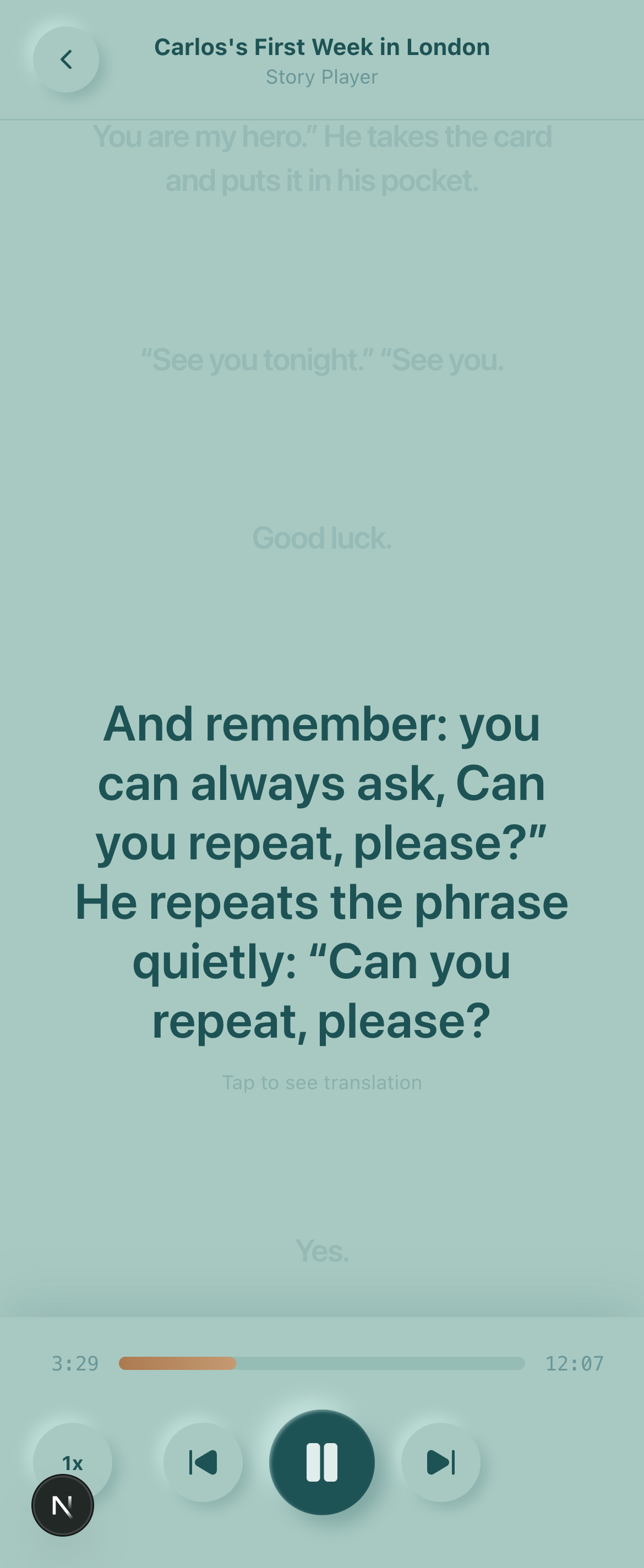
Carlos looks at a photo of his family in his small room in the London house share. He whispers: "This is my family." You understand it. You didn't translate. You didn't think about grammar. You lived the scene.
The English text moves with the audio. If you lose a sentence, you tap — and the Spanish translation appears. Only when you ask. Only when you need it. Your brain trains itself to understand first, translate later. That's how a language stops being code and becomes a language.
Researchers call this comprehensible input (Krashen, 1982). You're going to call it: finally.1
From your first sentence to a real argument. All inside a story.
Carlos is a Colombian chef in London. Lucía negotiates her salary in Manchester. Diego job-hunts in Liverpool. Paula tells her story of resilience in Bristol. Each one has a name, a city, a real problem.
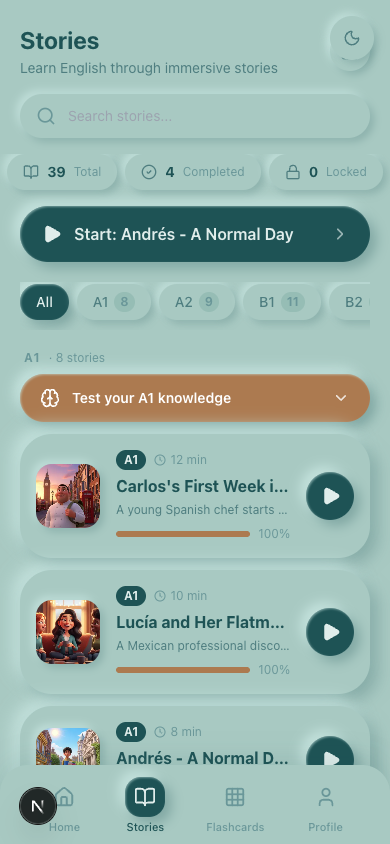
45 graded stories with British-accent audio. From A1 (knowing how to introduce yourself) to C1 (using English flexibly in demanding contexts). You choose the level where you want to start and move up when you prove you understood — not when you collect points.
Your brain acquires a language when it lives it, not when it studies it.
In 1982, linguist Stephen Krashen proposed something that changed language teaching forever: we acquire a language when we receive messages we almost fully understand — not when we memorise rules. He called it the comprehensible input hypothesis. Four decades later, it remains the most evidence-backed theory in second language acquisition research.
Every NexSpeak story is designed to give you exactly that: real English, slightly above your level, wrapped in a narrative that makes you want to keep listening. Grammar isn't explained. It's absorbed.
"Acquisition happens when learners receive input slightly above their current level, focused on meaning rather than form."
Krashen, S. D. (1982). Principles and Practice in Second Language Acquisition. Oxford: Pergamon Press.
Step into the first story. Twelve minutes.
Carlos is 35. He's a chef. He arrived in London from Colombia with a suitcase and textbook English. His room in the house share is small — two old chairs, boxes on the floor — but it's warm and quiet at night.
In the first twelve minutes of audio, Carlos introduces himself, describes his room, looks at a photo of his family, walks to the kitchen where he works, and starts his first shift with Ben. All in British English, at normal speed.
And you, without noticing, have absorbed eight grammar structures: "I am ok", "this is my family", "there are two old chairs", "it is warm"... You heard them in context, with emotion, inside a real scene. You didn't memorise them. You lived them.
After the audio come five comprehension questions — not memory questions, real comprehension: "Why does Carlos smile when he looks at the photo?". Get it right, you move on. Miss it, and the app points you to the exact moment in the audio and invites you to listen again. You don't level up with points here. You level up when your brain proves it understood.
45 stories. More than 400 structures. A language that finally belongs to you.
From Carlos's first week in London to Paula's toughest negotiation in Bristol. Every story is a step. Every step brings you closer to the English you need to live, work, and thrive in the UK.
And every structure you absorb in a story becomes a mnemonic flashcard — an image designed to help you remember it. And every flashcard comes back at intervals scheduled from your answers. Stories to understand. Images to remember. Questions to consolidate. Timing to review. That's the NexSpeak method.
The first story is Carlos's. Twelve minutes. Free.
All 8 A1 stories are free. From A2 onwards, access requires a subscription.
Making typical Spanish-speaker mistakes? Read our guide on the most common mistakes Spanish speakers make in English.
References
- 1.
Krashen, S. D. (1982). Principles and Practice in Second Language Acquisition. Oxford: Pergamon Press. Author-authorised PDF available at sdkrashen.com. The foundational text on the comprehensible input hypothesis. DOI