
An image designed to help you remember.
You've been repeating vocabulary lists that vanish within a month. There is another way.
You've copied irregular verbs into notebooks. You've drilled generic flashcards until boredom set in. And three days later, nothing. Your brain discards what it doesn't care about. It's not your fault. It's that nobody gave it a reason to remember. NexSpeak gives it that reason: a concrete, exaggerated image made for each sentence. One image for every English sentence you learn. More than 400.
The black hole of memory
You open the app. You study ten new words. You repeat them three times. The next day you remember six. After a week, two. After a month, none. This is the forgetting curve — a phenomenon science has been measuring since 1885 — and every app you've tried fights it with the same weapon: repeat, repeat, repeat.
But repetition without an anchor is like filling a bucket full of holes. It doesn't matter how much water you pour in. It escapes.
The problem isn't how many times you repeat. It's that there is nothing in your brain to hold the memory. No image. No story. No absurd scene your memory can grab onto the way it grabs your street name or the face of your first teacher. Just loose words floating in the void.
Your brain remembers images. We give it images.
The system is called the peg-word mnemonic: a classic memory technique that links every number to a fixed image. Applying it to English sentences is our own design: every sentence you learn has its own number and its own image. Here's how it works:
Every sentence has a number. Every number has a fixed image.
NexSpeak teaches more than 400 sentences, from A1 to C1. Each one has a unique number, like a labelled drawer. And each number, through a sound code (the Major system), always becomes the same concrete Spanish word: 0 is "oso" (bear), 1 is "té" (tea), 2 is "Noé" (Noah)... An abstract number becomes something you can see. That is how you know which drawer each sentence is in.
A concrete scene that leaves a cue.
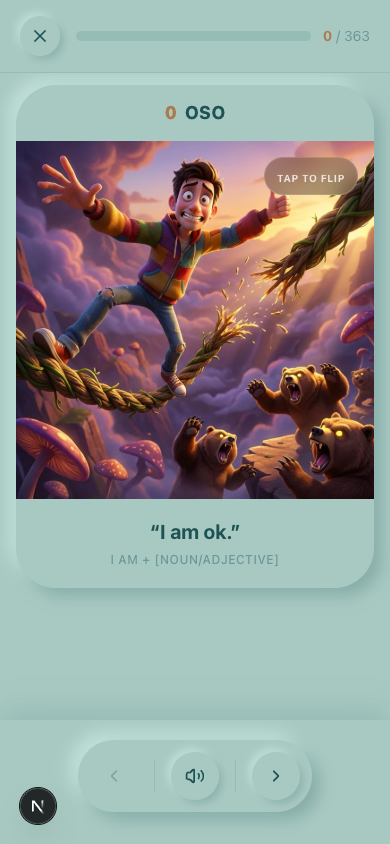
Sentence number 0 is "I am ok" (structure "I am + [adjective]"). Its peg word is "oso" (bear). The scene: a boy is balancing on a rope that is snapping, and four bears are waiting below. He keeps his cool, gives a thumbs-up and says "I am ok". The bears do not speak: they are the mark of number 0. A concrete scene, with emotion and unlike the others, leaves a clear cue that helps you find the sentence.
The app schedules when to practise again.
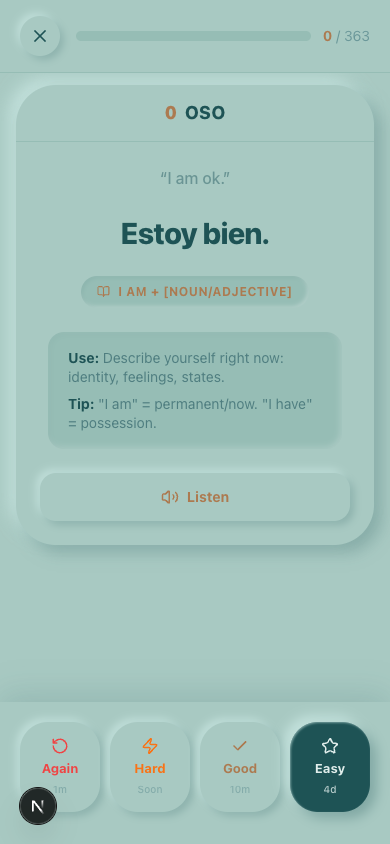
After you practise a flashcard, the spaced repetition system (SRS) schedules the next review from your response. Intervals change with your performance, and the app keeps track so you can focus on practising.
It's not a trick. It's a classic memory technique.
In 1971, psychologist Allan Paivio proposed dual coding theory: what is stored as both a word and an image is remembered better than what is stored as a word alone. Every NexSpeak flashcard brings together an image, an English sentence and its native audio: image and sound help each other, two routes to the same sentence. But the image alone is not enough: without review, what you learn with images is forgotten too. That is why every card comes back through spaced review. The image helps you find the sentence; the reviews help it stay.1
What is encoded both as a word and as an image is remembered better than what is encoded as a word alone; and concrete words better than abstract ones.
Look. This is flashcard number zero.
Let's run a test. The first English structure in NexSpeak is the most basic one there is: "I am + [adjective]". Its number is 0. Its peg word is "bear".
Now picture the scene: a boy is balancing on a rope that is snapping; the fibres are flying. Below, four bears wait with their claws up. He keeps his cool, gives a thumbs-up and says: "I am ok." No screaming. Just "I am ok" as the rope gives way.
Close your eyes for five seconds.
When the bears come to mind again, check whether the scene helps you retrieve the sentence. That visual association, combined with practice and spaced repetition, is the basis of NexSpeak mnemonics: the image helps you find the sentence; the reviews help it stay. This is the first of 414 flashcards.
414 flashcards. More than 400 structures. More than one route to recall.
From "I am ok" to advanced C1 English. Every sentence has its number, its image, its scene. And every scene you lived first inside a real story — because NexSpeak's mnemonics don't work alone. They work with the stories, the tests, and spaced repetition. It's a complete system.
This is one of the four pillars of the NexSpeak method. But the best way to understand it is not to read about it. It's to try it.
The first story and its flashcards are free. You decide when.
Heard of false friends? Read our guide on the most dangerous false friends between English and Spanish.
Reference
- 1.
Paivio, A. (1971). Imagery and Verbal Processes. New York: Holt, Rinehart & Winston. Reissued by Routledge (2013). Dual Coding Theory: verbal items paired with mental images are recalled significantly better. DOI