
The NexSpeak method: phrases you use from day one, learned inside stories. No points.
The problem isn't your English. It's how you were taught.
You've spent years writing verb tables into notebooks you never opened again. You've kept streaks alive in apps that handed you crowns while you still couldn't hold a conversation with your boss. You memorised vocabulary lists that vanished within a month. You're not short on effort. You're short on something nobody gave you.
Carlos, a Colombian chef, started from scratch three months ago in London. Today he runs his shifts in English. Below we walk you through what changed — one act at a time, no shortcuts, no strange promises.
The method in 5 pillars. The journey in 9 acts.
The door with no toll
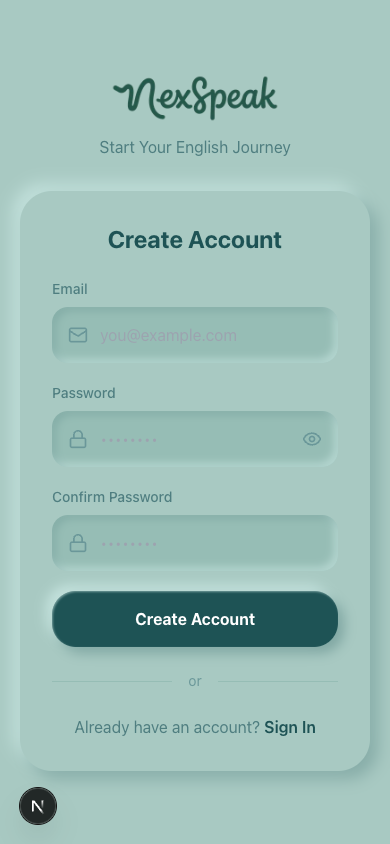
You decide to look inside. The app asks for your email. Nothing else. No card. No plan to pick. No 30-minute discount timer. No streak to defend from day one.
We give you the whole first story for free. Then the second. Then the third. When you feel this is your method — when English starts slipping into your headphones without you noticing — you decide if you stay.
Our first gesture with you is to give, not to take.
Step in. We open the door, not the bill.
Your real level. The one nobody ever told you.
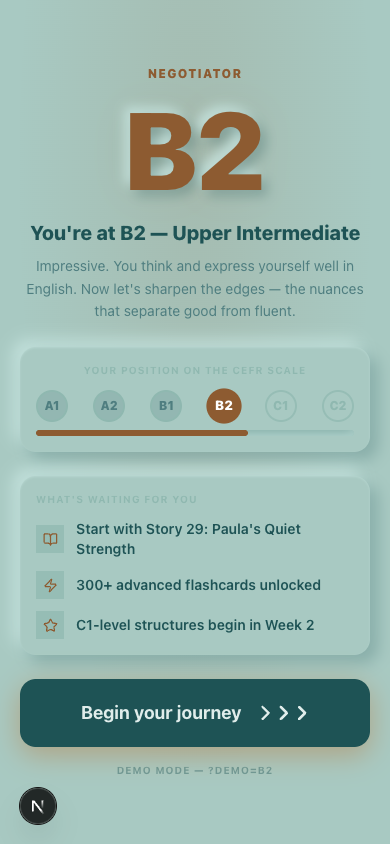
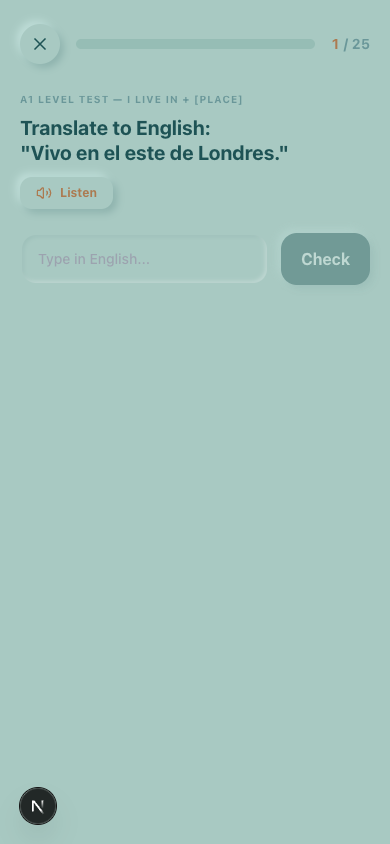
First, you choose where to start. Go straight to the first story, or open the structure test for the level you're interested in: sentences from that level, a couple of minutes, and you see which ones you know and which you don't. There's no exam that assigns you a level: you decide, with data.
That number wasn't given to you by the language school where you spent £400. It wasn't given to you by any app after 400 days of streak. It's been around for decades under the same international name — CEFR, a European scale that runs from 'can introduce yourself' to 'can argue politics' — and today, in two minutes, you finally know where you actually stand.
You don't have to prove anything to anyone. Just to yourself.
You know where you are. Now see where you can go.
A story, not a lesson
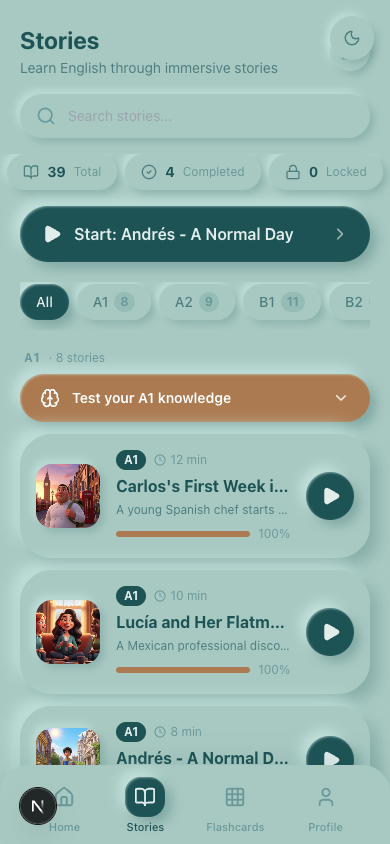
A screen opens. It's not an exercise. It's not Lesson 1. It's a cover: Carlos's First Week in London. A Colombian chef, 35, newly arrived, sharing a flat with Ben and a small bedroom. Twelve minutes of audio. British English.
Neither you nor Carlos have cracked a grammar book yet. But when he looks at a photo of his family and whispers "This is my family", you get it. Not because you translated. Because you lived the scene with him.
That's how we learn here. Story first. Grammar settles in on its own after. Here you don't start a lesson — you start Carlos.
Open Carlos's story. 12 minutes. Real English.
Tune the radio before the show
You've tried English podcasts and quit. Thirty seconds in, you were lost. That's normal — you walked into the audio cold. Not here.
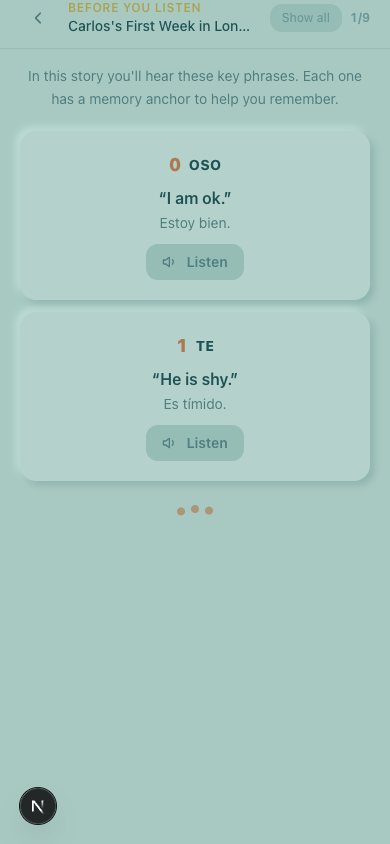
Before Carlos says a word, the app shows you the structures you're about to hear. One by one, each with its own image: a boy balancing on a rope that is snapping, four bears waiting below, giving a thumbs-up and saying "I am ok"; a lightning bolt with the kitchen orders hanging from it, "there are tickets on the line". Ninety seconds. It's not studying. It's tuning in. When those same sentences reach you in Carlos's voice, your brain is already waiting for them.
Cognitive science calls this pre-exposure (priming). We call it tuning the radio before the show1.
See what your brain is about to hear — before it hears it.
When English stops being a code
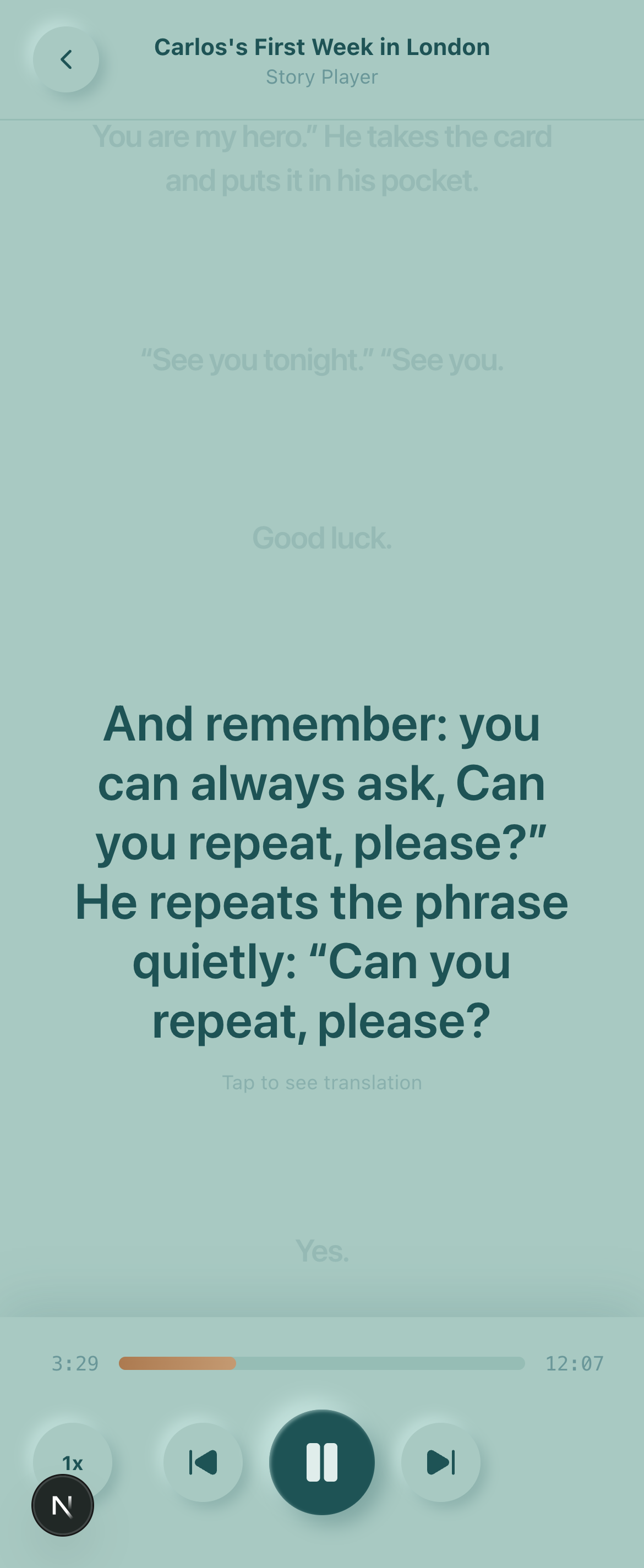
Play. The synthetic voice with a British accent begins. The English text moves on your screen. Carlos looks at the photo of his family. He whispers "This is my family". You understand it. Your brain didn't translate — it recognised.
If you lose a word in the next sentence, you tap, and Spanish appears. Only when you ask. Not before, not always. Every time you choose to understand before asking for a translation, your brain trains itself. Twelve minutes in, without noticing, you've just spent a week in London with Carlos — in English.
What you just lived is what researchers call comprehensible input (Krashen, 1982). The idea is simple: language is picked up the way habits are picked up — by being surrounded by English you understand almost entirely, and letting your brain handle the rest. We added stories with characters you start to care about. That "almost" is the distance between studying and living.2.
Press play. Let Carlos tell you.
You don't level up just by opening the app
After the audio, five questions. Not memory questions. Comprehension questions. "Why does Carlos smile when he looks at the photo?". "Where is his suitcase?". Get it right, you move on. Miss one, and the app points you to the exact moment in the audio where the answer was — and invites you to listen again.
No crowns. No points. No fake "great job!" when you guessed. You move forward only when your brain proves it understood. That's it.
Scientists call this the testing effect: every time you try to recall something, you learn it more than by rereading it (Roediger & Karpicke, 2006). We call it: not lying to the person doing the work. We treat you like the adult you are.3.
Answer. If you miss, you go back to the scene. No trick.
The flashcard of the bear
Look at the image. A boy is balancing on a rope that is snapping; four bears are waiting below. He keeps his cool and gives a thumbs-up. Under it, a single sentence: "I am ok.". Close your eyes for five seconds. Think of the bears.
This sentence lives at number 0, and in NexSpeak 0 is always a bear. When the bears come to mind again, check whether the scene helps you retrieve the sentence. Bear (oso) is what we call a peg word: a fixed visual cue for each number. It is a classic memory technique; applying it to sentences is our own design, and we combine it with practice and spaced review. The image helps you find the sentence; the reviews help it stay.
Not a trick. It draws on what psychologists call dual coding theory (Paivio, 1971): what you store as both an image and a word is remembered better than as a word alone. Image and sound help each other: two routes to the same sentence.4.

Estructura #1 — "I am + [adj]"
Look at this flashcard. If you still remember it tomorrow, you'll know I was right.
Coming back just before forgetting
"I learn things and they're gone in three days." Most adults who quit a learning app say something like that. It's real. Your brain forgets along a curve Hermann Ebbinghaus traced in a Berlin lab in 1885. Nobody gets to cheat it.
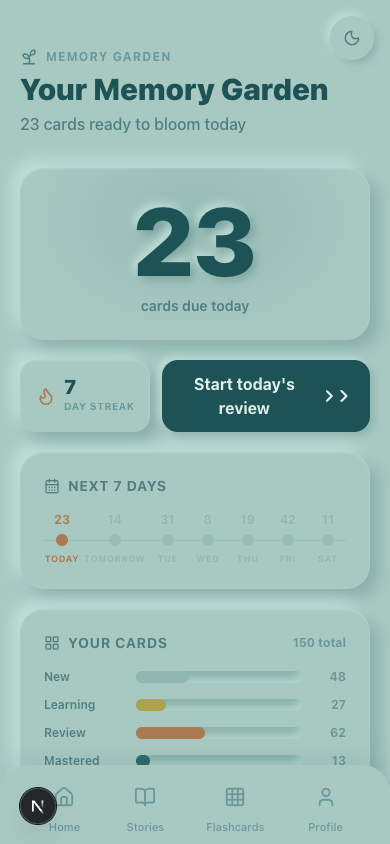
But you can dance with it. Tomorrow at this hour, the app will hand you back three of Carlos's flashcards. On day three, again. On day seven, once more. Each review is scheduled from how you answered the last one. You don't keep count — the system does. You just show up. We handle the rest.
This is called spaced repetition (Cepeda et al., 2006). All NexSpeak does is use it well: 45 stories, more than 400 CEFR structures from A1 to C1, mnemonic flashcards, and a system that schedules when to show you each one again, based on your answers. If you're someone without three free hours a day — and you are, that's why you're here — this is what shifts the equation.5.
That's the method. Now it's your turn to decide.
Questions about the method
Honest answers, no hype.
Three months from now
Three months after stepping into Carlos's story, you aren't learning English. You're living in English.
Stories to understand. Images to remember. Questions to consolidate. Timing to review. That's the method.
First story free. No card. You decide when you're in.
References
- 1.
Pre-exposure / priming. Presenting target structures before the main input aligns with priming effects well-documented in cognitive psychology and routinely applied in comprehensible-input pedagogies.
- 2.
Krashen, S. D. (1982). Principles and Practice in Second Language Acquisition. Oxford: Pergamon Press. Author-authorised PDF available at sdkrashen.com. The foundational text on the comprehensible input hypothesis. DOI
- 3.
Roediger, H. L., & Karpicke, J. D. (2006). "Test-Enhanced Learning: Taking Memory Tests Improves Long-Term Retention". Psychological Science, 17(3), 249–255. Retrieving a memory strengthens it more than rereading. DOI
- 4.
Paivio, A. (1971). Imagery and Verbal Processes. New York: Holt, Rinehart & Winston. Reissued by Routledge (2013). Dual Coding Theory: verbal items paired with mental images are recalled significantly better. DOI
- 5.
Cepeda, N. J., Pashler, H., Vul, E., Wixted, J. T., & Rohrer, D. (2006). "Distributed practice in verbal recall tasks: A review and quantitative synthesis". Psychological Bulletin, 132(3), 354–380. Meta-analysis over 839 assessments: spaced practice robustly beats massed practice. DOI
- 6.
The two core techniques at the heart of this method — active recall and spaced repetition — are the only two that the largest modern review of study strategies rates as high utility across all ages and subjects (Dunlosky et al., 2013). DOI